
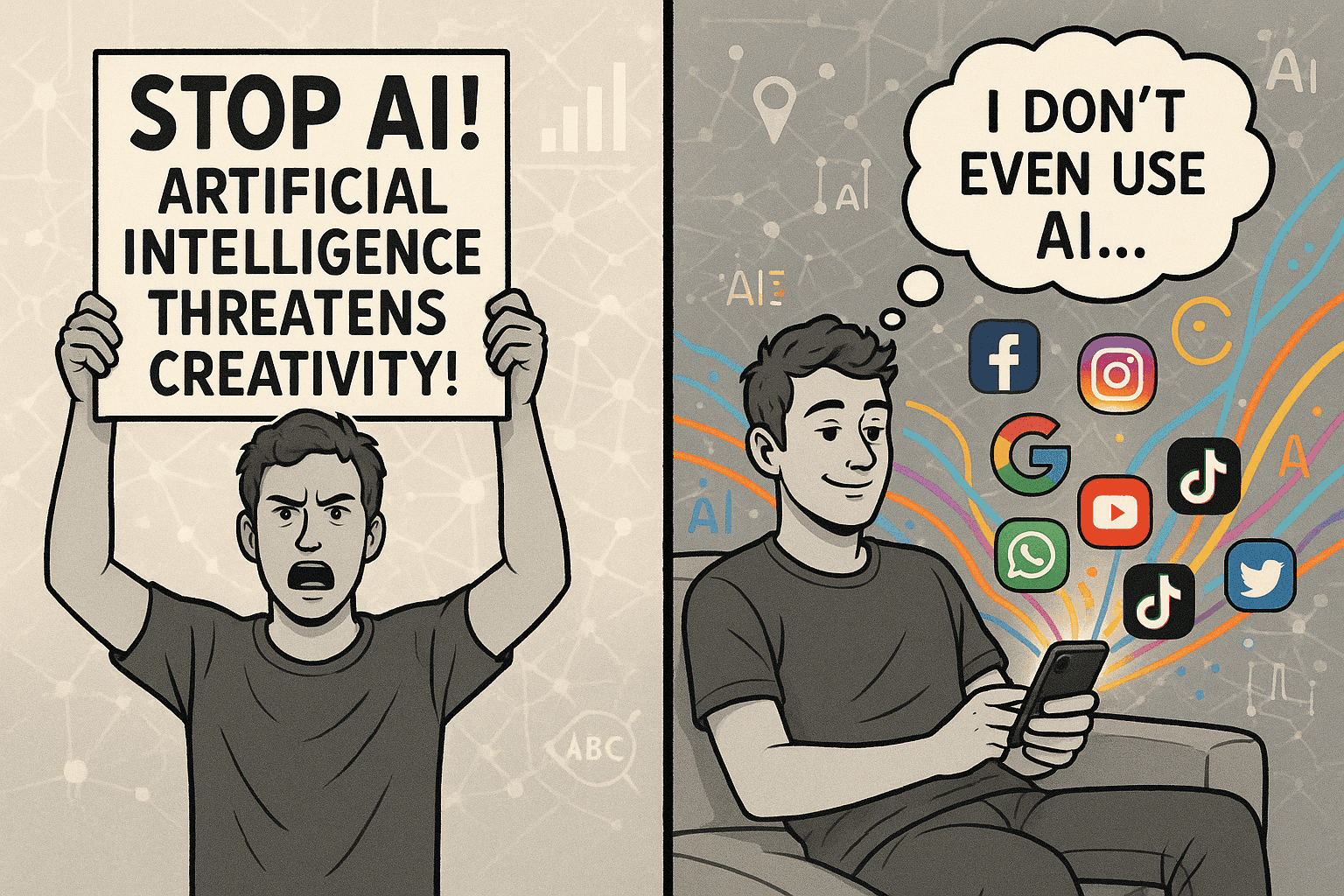
Have you ever met someone who loudly opposes artificial intelligence, calling it a threat to human creativity, while simultaneously scrolling through Instagram feeds, reading Facebook recommendations, or searching for information on Google every day? This seemingly absurd situation is now a daily reality for millions of people worldwide. It turns out that most of us live in an illusion of choice, criticizing AI while being completely dependent on it. Research shows that while only 33% of people believe they use AI, over 77% actually use services or devices powered by artificial intelligence. The situation looks similar in Poland - although 87% of Poles have heard about artificial intelligence, only 23% declare they understand how specific AI tools work. This very lack of awareness forms the foundation of contemporary technological hypocrisy.
Facebook and Instagram: The Empire of Algorithms
Meta, owner of Facebook and Instagram, is one of the most advanced AI companies in the world. Every interaction on these platforms is analyzed by artificial intelligence systems. Facebook uses machine learning to analyze user behavior and personalize content displayed in the News Feed, analyzing billions of interactions daily. The algorithm considers over 100,000 different signals to decide the order of posts.
Meta AI automatically moderates content, detecting hate speech, misinformation, and harmful content in real-time. Between April and June 2020, Facebook removed 22.2 million posts containing hate speech, primarily using AI systems. Additionally, new AI features in Instagram allow generating stickers, backgrounds, and filters, as well as creating content using simple text prompts.
The irony is that AI opponents who criticize "stealing from artists" simultaneously use AR filters powered by AI, automatic collages, and personalized content, which are exactly what critics call "artificial" and "inauthentic."
Google: AI in Every Click
Google is probably the largest AI user in the world, though this remains invisible to most people. Every Google search is handled by AI algorithms that analyze queries and deliver personalized results. Google Assistant, Google Translate, Gmail's spam filters, Google Photos - all are based on advanced artificial intelligence systems.
Particularly interesting is that Google uses AI to predict user behavior, automatically complete searches, and personalize ads. Even simple features like autocorrect in smartphones are advanced AI systems using natural language processing.
TikTok and YouTube: Addiction Algorithms
The TikTok Algorithm is powered by artificial intelligence and machine learning that constantly analyze user behavior. This system can detect music preferences, physical attractiveness, or even signs of depression in users within hours. TikTok needs only one piece of information: how much time you spend watching specific content - every second of hesitation is tracked and analyzed.
YouTube uses deep learning systems for video recommendations, analyzing hundreds of billions of examples and learning from approximately one billion parameters. YouTube's algorithm powers 70% of what people watch on the platform, using advanced AI systems to personalize content based on viewing history, engagement, and behavioral patterns.
WhatsApp, Snapchat, and Twitter: AI Everywhere
Even seemingly "simple" apps like WhatsApp integrate advanced AI features. Meta AI in WhatsApp can analyze images, answer questions, and generate content. Snapchat uses AI for face recognition, AR filters, and automatic image description generation. Twitter (X) uses AI for content moderation, bot detection, and timeline personalization.
Each of these platforms uses artificial intelligence to analyze millions of daily interactions, creating detailed user profiles and predicting their behavior. AI opponents, using these platforms, daily feed AI systems with their data while simultaneously opposing this technology.
Statistics of Unconsciousness
Research data shows the scale of this problem. In Poland, 55% of respondents admit they don't consciously use AI-based solutions professionally. However, in private life, Poles most commonly experience AI through maps and GPS (62%) and autocorrect and text suggestions (54%).
Globally, the situation is similar - employees often don't know whether their companies use artificial intelligence. 54% of workers cannot answer whether AI is used in their workplace. This unconsciousness leads to cognitive dissonance - people oppose AI in theory but accept it in practice.
Hidden AI Features in Daily Life
Modern smartphones are full of hidden AI features that most users don't perceive as artificial intelligence. Modern phones use AI for automatic camera settings adjustment, battery optimization, speech recognition, and interface personalization.
AI systems work in the background when using public transportation (smart ticket machines), ATMs (fraud detection), navigation (route optimization), and even when shopping online (product recommendations). We encounter artificial intelligence during daily use of public spaces, often without knowing it.
Selective Opposition
AI opponents often focus on visible applications, such as image generators, ignoring invisible AI systems that already control their digital experiences. This selective opposition stems from a lack of understanding of how deeply artificial intelligence is already integrated into daily life
Researchers note that people more often change their minds to suggested ones when they think it comes from AI - even if it was actually authored by a human. This shows that our relationship with AI is complex and full of contradictions.
Hidden AI Usage
Microsoft reports that 78% of AI users bring their own AI tools to work, and 46% started using them within the last six months. Additionally, 52% are reluctant to admit using AI help with important tasks. This phenomenon of "hidden usage" shows how widespread AI has become, even among people who officially oppose it.
Economic Dimension of Hypocrisy
The AI market in social media was worth $2.45 billion in 2024 and is predicted to reach $54.07 billion by 2034. Every social media platform user directly supports AI technology development through their activity, regardless of their own views on artificial intelligence.
Companies like Meta generate billions of dollars through AI systems, particularly in advertising and targeting. AI opponents, using Facebook or Instagram, unknowingly finance the development of this technology while criticizing it.
Future of Unconscious AI
Technology development makes AI even more invisible. New features like on-device AI using models such as Gemini Nano mean that artificial intelligence will be even more deeply integrated with our devices, often working offline and without our awareness.
Meta plans to introduce even more AI features, including virtual characters powered by AI, which will further deepen the hypocrisy of social media platform usage by artificial intelligence opponents.
Conclusions: Time for an Honest Debate
The fundamental truth is this: if you use Facebook, Instagram, Google, YouTube, TikTok, or practically any modern digital platform, you've been intensively using artificial intelligence for years. Opposition to AI while simultaneously using AI-powered systems daily is a classic example of cognitive dissonance.
This hypocrisy undermines the credibility of AI opponents' arguments and shows how deeply artificial intelligence is already integrated into our daily lives. The real debate about AI should focus not on whether to use it, but on how to use it responsibly - because for most of us, Psychology of Hypocrisy Selective Opposition Hidden AI Usage Economic Dimension of Hypocrisy Future of Unconscious AI Conclusions: Time for an Honest Debate including AI opponents, artificial intelligence is already an integral part of our daily digital experience.
Maybe it's time to stop pretending we have a choice and start discussing how to consciously shape the future of technology that we all already use?
.png&w=640&q=75)